English Pronunciation Classes for Adults | UCEDA School

UCEDA School offers structured English pronunciation instruction for adult learners who want to speak more clearly and be better understood at work and in daily life.

English Pronunciation Classes for Adults

Many adults who have studied English for years, and who understand English well when they read it, still struggle to be understood when they speak. Pronunciation is often the last skill to develop and the hardest to improve without structured instruction. Informal English practice, television, and apps can expose you to how English sounds, but they rarely give you the systematic feedback and phonetic instruction that produce lasting improvement.

UCEDA School’s English program includes pronunciation instruction as an integrated part of every level. Unlike pronunciation apps that score you against a machine, our qualified instructors provide the kind of real-time, human feedback that identifies your specific pronunciation patterns and helps you correct them. With new classes beginning every Monday at campuses in Provo, Utah, Las Vegas, Nevada, and West Palm Beach, Florida, you can start building clearer English speech this week.

Why Pronunciation Matters for Adult Learners

Pronunciation affects more than how you sound. It directly determines how well you are understood, and being understood is what makes English useful in professional and social settings.

At work, unclear pronunciation means repeating yourself more often, being misunderstood in meetings, or being passed over for client-facing roles that require clear spoken English. In healthcare, mispronounced drug names, patient instructions, or clinical terms can have serious consequences. In customer service, hospitality, and sales, your spoken English is the primary tool of your job, and unclear pronunciation limits what you can accomplish.

Beyond the workplace, pronunciation affects confidence. Many adult learners with strong reading and writing skills are reluctant to speak in English because they are self-conscious about their accent or how they sound. This reluctance reinforces itself: the less you speak, the less you practice, and the more your pronunciation stays the same. Structured pronunciation instruction breaks this cycle by giving you a clear understanding of what to change and how.

The goal of pronunciation instruction is not to eliminate your accent. Every person, including native English speakers, has an accent. The goal is to reach a level of clarity where your speech does not interfere with communication, where you can be understood the first time, and where you feel confident speaking in any professional or social setting.

Why Pronunciation Is Hard to Improve on Your Own

Pronunciation is uniquely difficult to self-correct because you cannot hear yourself the way others hear you. Most adult learners with pronunciation challenges are not aware of the specific sounds they are producing incorrectly. They hear their own speech as correct, because their brain filters it through their first language’s sound system.

Without instruction, most learners make only gradual progress on pronunciation because they are reinforcing their existing patterns rather than replacing them. A Spanish speaker who produces the English short “i” sound as a long “e” will continue to say “sheep” when they mean “ship” and “beach” when they mean something else entirely unless someone explicitly teaches them the difference and provides repeated corrective feedback.

Pronunciation instruction at UCEDA School identifies these specific patterns for each student and provides the structured practice and feedback that produce real change. Our instructors are trained in the phonology of English and in the specific interference patterns that Spanish speakers, and speakers of other languages, bring to English pronunciation.

Key Pronunciation Skills Taught at UCEDA School

Vowel sounds: English has a larger and more complex vowel system than Spanish and most other languages. Many pronunciation challenges for adult learners come directly from vowel confusion, and a significant part of pronunciation instruction focuses on distinguishing and producing English vowel sounds accurately.

Consonant sounds: English includes consonant sounds that do not exist in Spanish and many other languages, including the “th” sounds, the “v” and “b” distinction, and the “r” sound, which is produced differently in English than in Spanish.

Word stress: English uses stress to distinguish word meaning in ways that other languages do not. Placing stress on the wrong syllable can make a familiar word completely unrecognizable to an English listener. Instruction in word stress patterns is a foundational part of developing clear English pronunciation.

Sentence rhythm and intonation: English has a characteristic rhythm, with stressed and unstressed syllables creating a pattern that native listeners use to follow speech. Learners who speak in a flat, even rhythm, or with the rhythm of their first language, are harder to understand even when individual words are pronounced correctly.

Linking and connected speech: Native English speakers link words together in ways that change how they sound in context. Instruction in connected speech helps learners both understand spoken English better and produce speech that sounds more natural and is easier for listeners to follow.

How UCEDA School Teaches Pronunciation

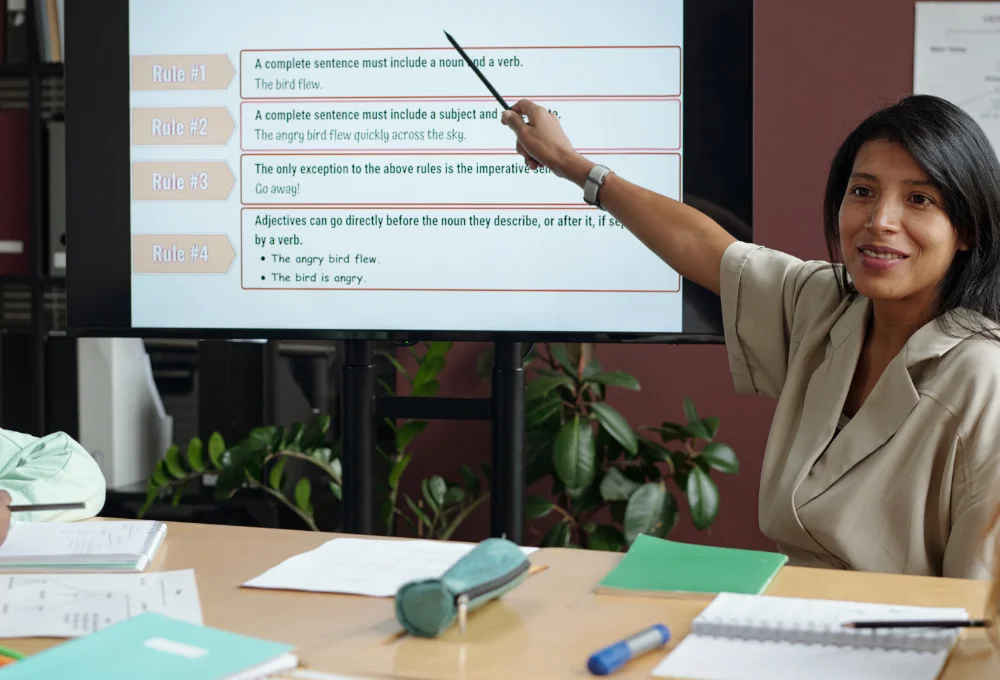
Pronunciation at UCEDA School is integrated into all three levels of the English program rather than treated as a separate add-on course. This integration matters because pronunciation improvement requires consistent practice over time, not a one-time workshop or a standalone unit.

At every level, instructors work with students on pronunciation as part of speaking activities, listening practice, and class discussions. Individual feedback is provided during class. Students practice sounds, stress patterns, and intonation in context rather than in isolation, which produces more durable improvement than drilling sounds out of context.

The three-level structure means that pronunciation instruction is calibrated to each student’s stage of development. Basic-level students work on foundational sounds and word stress. Intermediate students work on connected speech and sentence rhythm. Advanced students work on the subtler aspects of intonation and register that separate functional pronunciation from fully professional spoken English.
Level 1, Basic English (50 Weeks | CEFR A1-A2)

At the Basic Level, pronunciation instruction focuses on the English sound system: vowels, consonants, and the basic stress patterns that make English words recognizable. Students develop the ability to produce and distinguish the sounds that matter most for basic intelligibility, and begin to develop the listening skills needed to hear and self-monitor their own pronunciation with greater accuracy.

Level 2, Intermediate English (50 Weeks | CEFR B1-B2)

At the Intermediate Level, pronunciation work extends to sentence rhythm, linking, and intonation. Students develop the ability to produce English with the rhythm and flow that native listeners expect, which significantly improves how naturally and clearly they communicate in work and social settings. Vocabulary development at this level also reinforces pronunciation because students are learning correct stress patterns as part of learning new words.

Level 3, Advanced English (50 Weeks | CEFR C1-C2)

At the Advanced Level, pronunciation instruction addresses the subtle features of professional spoken English: precise intonation for emphasis and register, formal presentation speaking, and the kind of spoken fluency that allows you to communicate with full confidence in job interviews, client meetings, public presentations, and academic settings. Review the full English curriculum for details on all three levels.

Who Benefits Most from Pronunciation Instruction

Professionals in client-facing or customer-service roles who are frequently misunderstood on the phone or in person, who repeat themselves often, or who avoid speaking situations because of pronunciation anxiety.

Healthcare workers whose job requires clear communication in high-stakes clinical situations, where mispronounced drug names, symptoms, or instructions can create real risk.

Job seekers preparing for interviews in English, where spoken fluency and clear pronunciation significantly affect how interviewers evaluate confidence and professional readiness.

Intermediate-level learners who can read and write in English but whose speaking lags behind. This is one of the most common situations among adult ESL learners, and structured pronunciation instruction is the most direct path to closing the gap.

Managers and supervisors who lead English-speaking teams, conduct meetings, and give presentations in professional settings where spoken authority depends in part on clear, confident pronunciation.

Students preparing for naturalization, where the USCIS interview requires spoken English that an officer can clearly understand.

What a CEA-Accredited Certificate Says About Your English

When you complete a level at UCEDA School, you receive an English Language Certificate of Completion from a CEA-accredited institution. This certificate documents not just that you studied English, but that you completed a structured, nationally accredited program that develops all four language skills, including speaking. For employers, licensing boards, and immigration officials who want documented evidence of English language study, a certificate from UCEDA School carries more weight than a certificate from an unaccredited program.

Our Campus Locations

UCEDA School offers pronunciation instruction as part of all three levels at campuses in Utah, Nevada, and Florida. New classes begin every Monday.

UCEDA School Provo, Utah Address: 1675 N Freedom Blvd, Suites 12A, 9A, and 10F, Provo, UT 84604 Phone: (801) 762-9293 Email: ucedaprovo@gmail.com Classes Start: Every Monday Levels Available: Basic, Intermediate, Advanced

Learn more about the Provo campus

UCEDA School East Las Vegas, Nevada Address: 2785 E. Desert Inn Rd., Suite 100, Las Vegas, NV 89121 Phone: (702) 586-3131 Classes Start: Every Monday Levels Available: Basic, Intermediate, Advanced

Learn more about the Las Vegas campus

UCEDA School West Palm Beach, Florida Classes Start: Every Monday Levels Available: Basic, Intermediate, Advanced Contact us for address and hours

To confirm current campus information, schedules, and enrollment options, contact UCEDA School directly.

Frequently Asked Questions, English Pronunciation Classes

Yes. Adults can absolutely improve their pronunciation with structured instruction and consistent practice. The common belief that adults cannot change their accent is not supported by research. What is true is that adults require more deliberate instruction and practice than children, because they are working against established patterns. Structured instruction with qualified teachers is the most effective approach for adults.

No. The goal of pronunciation instruction is not accent elimination. It is clear, intelligible communication. Many people with noticeable accents communicate clearly and professionally in English every day. The goal is to reach the point where your pronunciation does not interfere with communication, which is entirely achievable through structured instruction.

Many students notice improvement within the first few weeks of consistent instruction and practice. Significant and durable improvement typically takes several months of consistent study. Pronunciation is a physical skill that requires repeated practice, similar to learning an instrument, and students who practice outside of class improve faster than those who only attend class.

Pronunciation instruction at UCEDA School is integrated into our full English program rather than offered as a standalone course. This integrated approach produces better results because pronunciation improvement happens faster when it is practiced in the context of real language use rather than drilled in isolation. If you want to focus specifically on pronunciation, the Intermediate Level is often the most relevant starting point. Contact UCEDA School to discuss your situation.

If you are at an advanced level of English and specifically want to work on accent and pronunciation, our Advanced Level may be appropriate for you. Contact our team to discuss your current level and goals. We will conduct a placement evaluation to determine the best starting point.

Spanish speakers are the largest group we work with, and there are well-documented pronunciation challenges specific to Spanish speakers in English, including the vowel system, the “th” sounds, the “v” and “b” distinction, and the differences in rhythm and stress. Our instructors are particularly experienced with these patterns. We also work with speakers of other languages and welcome learners from all linguistic backgrounds. Visit our page on English classes for Spanish speakers for more detail on our program for Spanish speakers.

Yes. UCEDA School is SEVP-certified and authorized to issue the I-20 form for F1 student visa applications. International students who want to study English full-time, including developing their pronunciation, can learn more through our resources for F1 international students.

Start Speaking More Clearly This Monday

UCEDA School’s CEA-accredited English program integrates pronunciation instruction into every level, with qualified teachers who provide the real-time feedback that apps and informal study cannot replicate. New classes begin every Monday at campuses in Provo, Las Vegas, and West Palm Beach.

If unclear pronunciation is limiting your confidence, your professional opportunities, or your ability to communicate the way you want to in English, structured instruction is the most direct path to improvement. Enroll at UCEDA School or contact us to discuss your pronunciation goals and find the right starting level.

ENGLISH COURSES

STUDENT VISAS

INTERNATIONAL STUDIES